River Lake has been assisting Bay of Plenty Regional Council with monitoring of Maketū Estuary. It has been six years since the Kaituna River was re-diverted back into the Maketū Estuary as part of the Kaituna River Re-diversion and Maketū Estuary Enhancement Project. This proejct returned at least 20% of the Kaituna River’s flow back to the estuary and restored salt marsh and wetland habitats.
Intensive monitoring has been undertaken for algae cover, sediment accumulation, sediment quality, banthic macrofauna communities, water quality, shellfish abundance and size, pipi surveys, and microbial water quality of shellfish.
Recent reporting has confirmed that the rediversion has dramatically reduced the cover of macroalgae, leading to improving macrofauna diversity and more abundance of shellfish thoughout much of the estuary. The increased flow from the Kaituna River has reduced salinity in the estuary and resulted in higher concentrations of nitrogen and microbial bacteria in the water. While the rediversion has been very succesful, continued efforts are still required to improve water quality across the catchment.
River Lake is undertaking monitoring of Maketū Estuary on behalf of Bay of Plenty Regional Council. We have been sampling water quality, microbial water quality of shellfish flesh, installing loggers, algal cover, sediment accumulation, sediment quality, benthic macrofauna and pipi surveys.
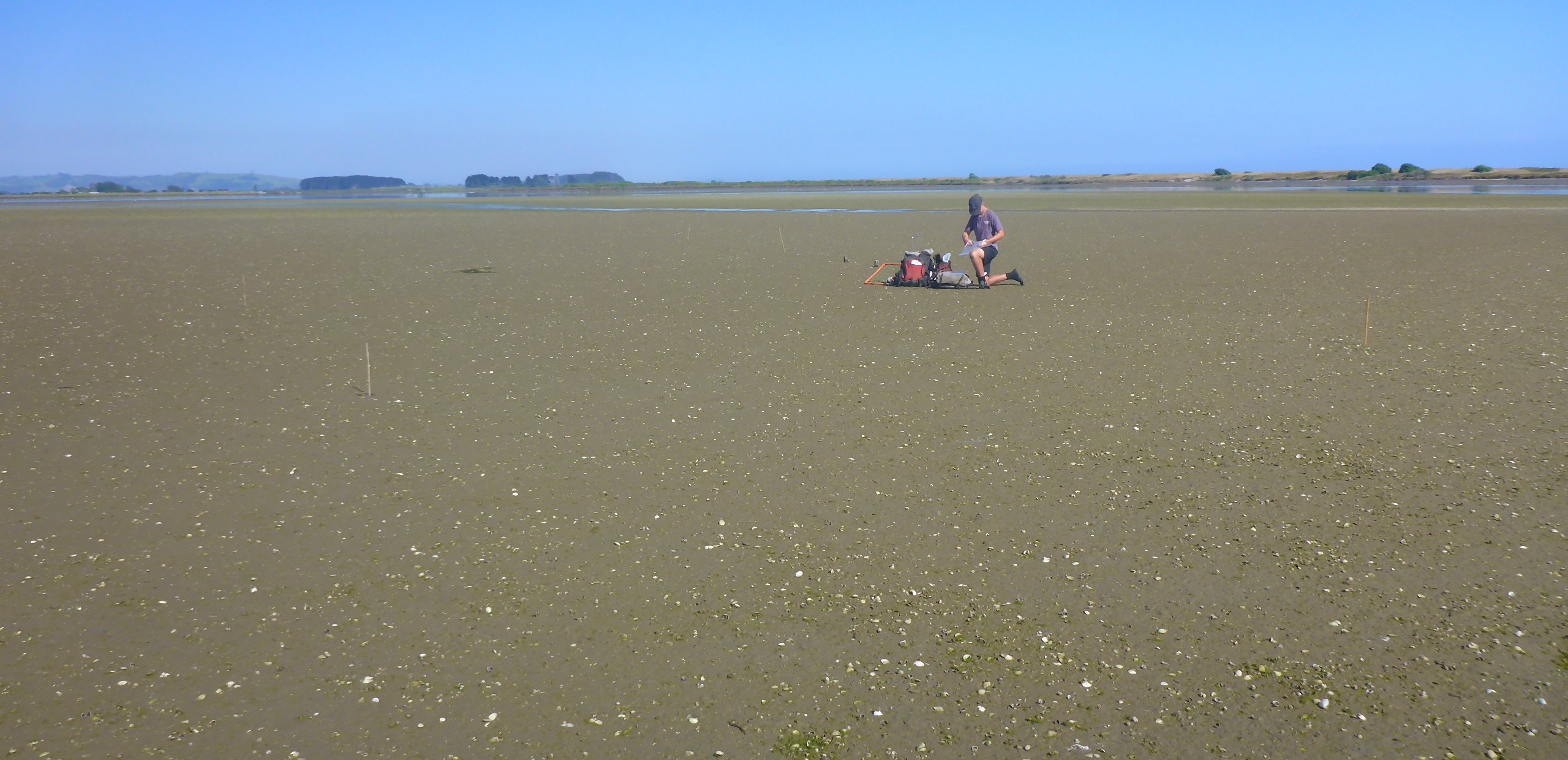
The monitoring protocol for macrofauna requires collecting 10 sediment cores per site so it doesn’t take long before we a carrying a heavy pack. We were lucky to have Tom in the field with his efficent sampling technique and strong shoulders.
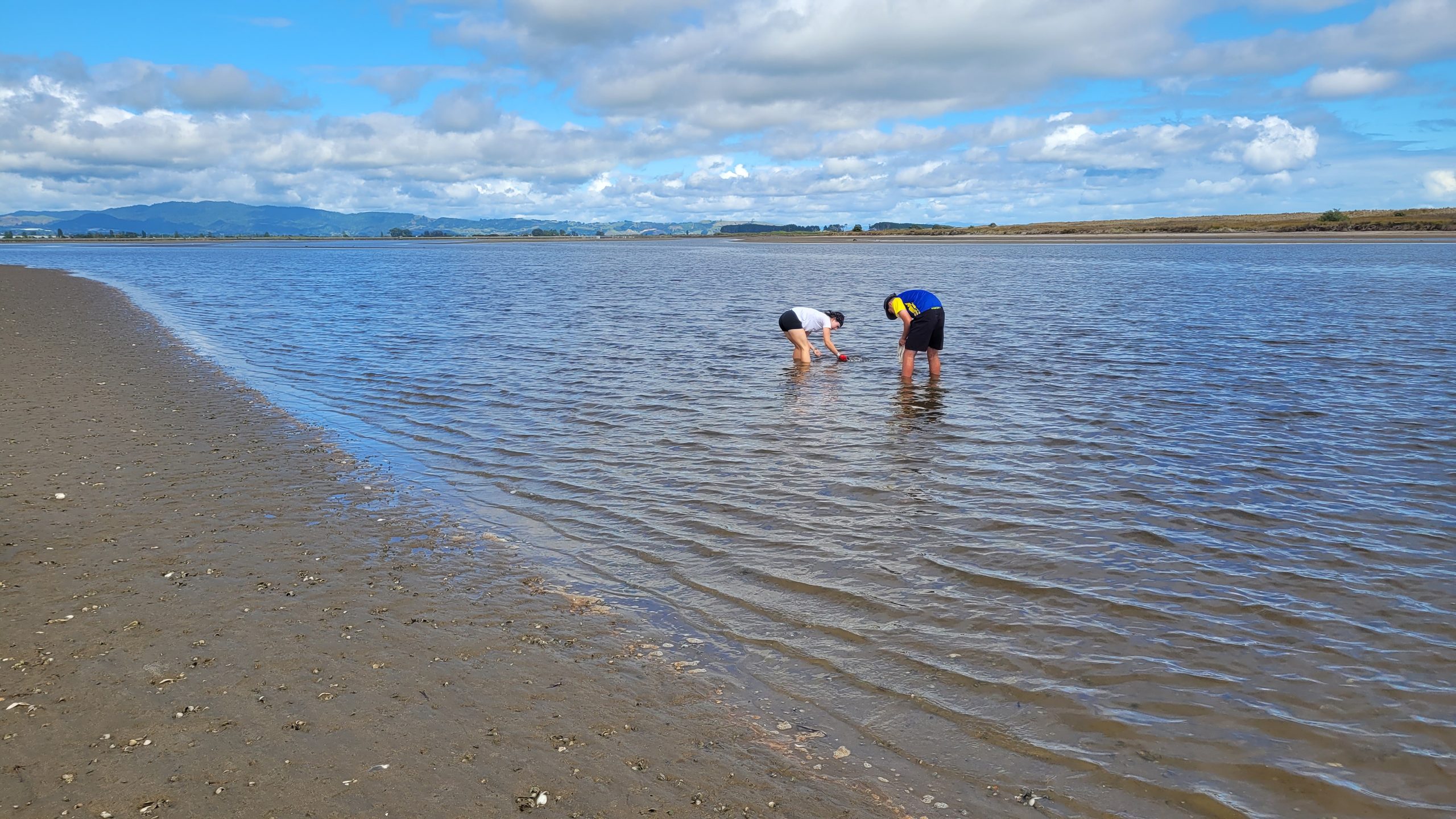
Tom collecting macrofauna samples and sediment plate measurements in Maketū Estuary December 2025.Collecting pipi and cockle for monitoring microbial quality in at Maketū Estuary, January 2026.
Te Awa o te Atua /Matatā lagoon is an outstanding example of a complex dune land-wetland-open-water system on a freshwater-saltwater interface. It has high botanical values and provides high value breeding and feeding habitat for a large number of water birds.
The western lagoon was remediated in about 2010, however the width of aquatic emergent wetland vegetation on the margin of the western lagoon remains considerably less than what was intended to regenerate into shallow wetland habitat following the post-flood remediation.
River Lake Ltd and Place Group undertook water quality, fish and vegetation surveys to assess the ecological health of Te Awa O Te Atua / Matatā Lagoon and identify ways to improve its values.
The report for Whakatane District Council can be found here:
River Lake contributed to the Lagoon Technical Group (LTG) and Catchment Technical Group (CTG) advising Southland Regional Council on interventions to protect and restore Waituna Lagoon.
Waituna Lagoon is a highly valued, large brackish coastal lagoon and a wetland of international importance (Ramsar site). Ruppia (seagrass) is a key stone species central to the ecological functioning, of the lagoon. It is threatened by nuisance filamentous algae, sedimentation, an an opening regime that can increase salinity when the seagrass is germinating.
Our work included:
Analysing water quality state and trends;
Assessing the risk of the lagoon ‘flipping’ to a dirty water state;
Contributing the the development of lagoon guidelines with quality targets for lagoon health, and management options.
Floating mats of the cyanobacteria Lyngbya sp. in an isolated section of the Maketu-Ongatoro Estuary. Reducing this cover of algae is one reason for the Kaituna River Re-Diversion Project (Bay of Plenty Regional Council).