River Lake has been assisting Bay of Plenty Regional Council with monitoring of Maketū Estuary. It has been six years since the Kaituna River was re-diverted back into the Maketū Estuary as part of the Kaituna River Re-diversion and Maketū Estuary Enhancement Project. This proejct returned at least 20% of the Kaituna River’s flow back to the estuary and restored salt marsh and wetland habitats.
Intensive monitoring has been undertaken for algae cover, sediment accumulation, sediment quality, banthic macrofauna communities, water quality, shellfish abundance and size, pipi surveys, and microbial water quality of shellfish.
Recent reporting has confirmed that the rediversion has dramatically reduced the cover of macroalgae, leading to improving macrofauna diversity and more abundance of shellfish thoughout much of the estuary. The increased flow from the Kaituna River has reduced salinity in the estuary and resulted in higher concentrations of nitrogen and microbial bacteria in the water. While the rediversion has been very succesful, continued efforts are still required to improve water quality across the catchment.
River Lake is undertaking monitoring of Maketū Estuary on behalf of Bay of Plenty Regional Council. We have been sampling water quality, microbial water quality of shellfish flesh, installing loggers, algal cover, sediment accumulation, sediment quality, benthic macrofauna and pipi surveys.
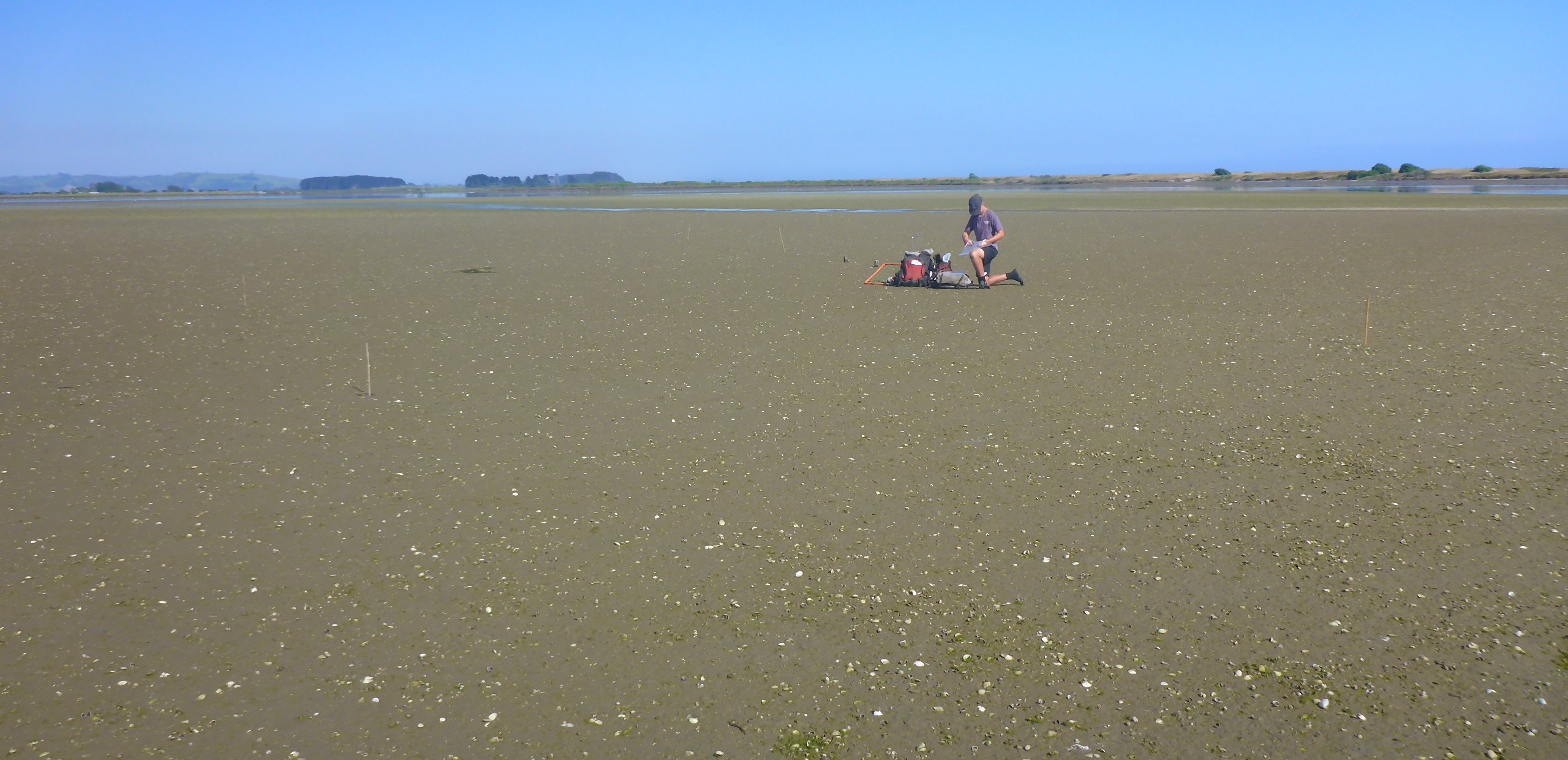
The monitoring protocol for macrofauna requires collecting 10 sediment cores per site so it doesn’t take long before we a carrying a heavy pack. We were lucky to have Tom in the field with his efficent sampling technique and strong shoulders.
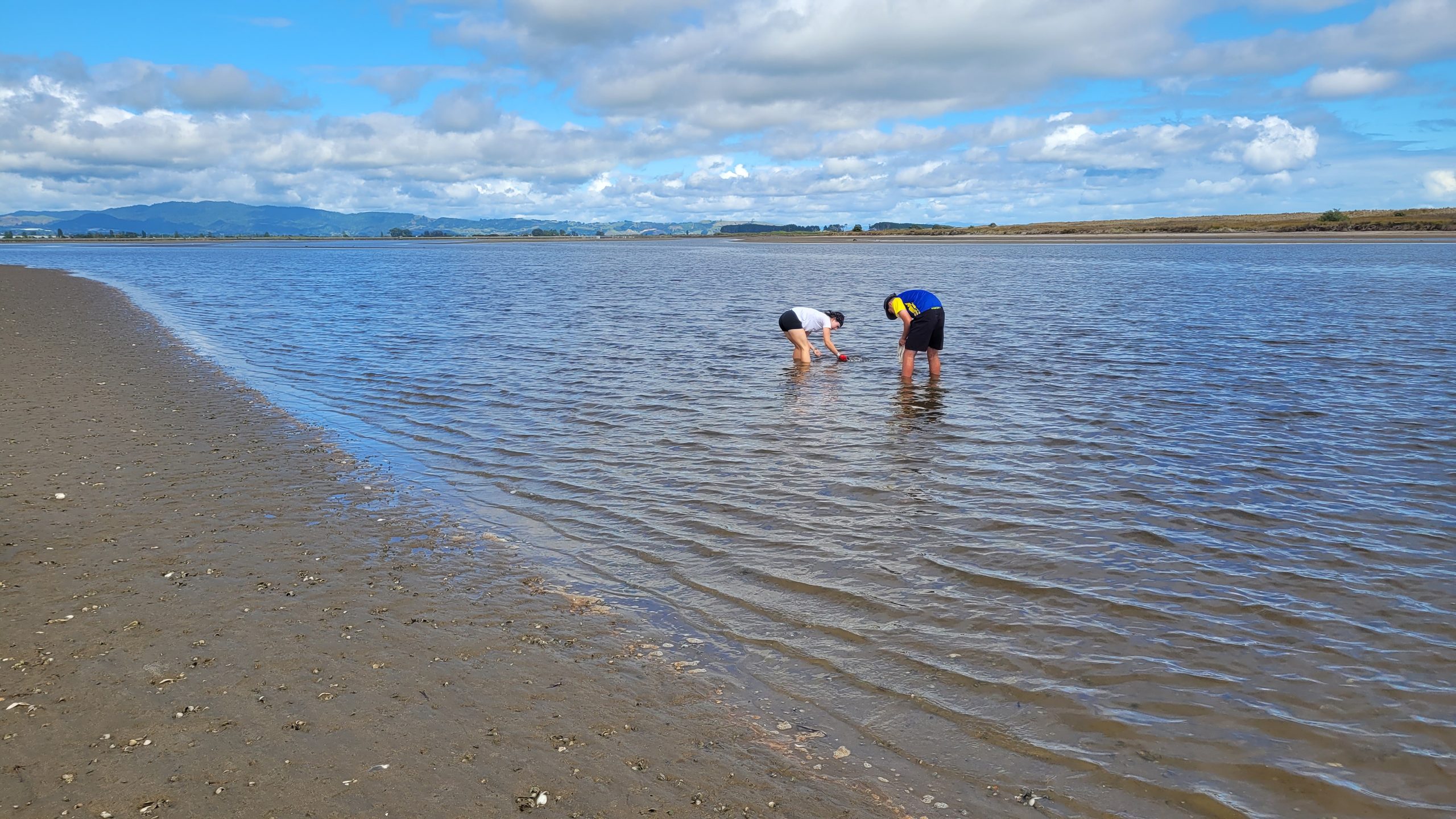
Tom collecting macrofauna samples and sediment plate measurements in Maketū Estuary December 2025.Collecting pipi and cockle for monitoring microbial quality in at Maketū Estuary, January 2026.
River Lake studied the mixing of diagonal drain pump station with the lower Kaituna River. We used Rhotomine dye WT to understand how well the pump station discharge mixed across the Kaituna River before the intake for the new diversion to Maketū Estuary.
The work was done for Bay of Plenty Regional Council rivers and drainage team.
Rhodamine WT dye entering the Kaituna River from the Diagonal Drain pump station, 2.3 km upstream from the river mouth (9 Nov 2017). Photo by Andy Belcher.Lower Kaituna River facing towards Maketū Estuary. The borrow pits are visible on the true right of the river. At this location discharges from Diagonal Drain had mixed across 50% to 70% of the river, depending on the tide (9 November 2017). Photo by Andy Belcher.
The Ongatoro/Maketū estuary is a shallow, inter-tidal estuary located north of Te Puke. In 1957 the Kaituna River was diverted directly to sea and the influence of the river on the estuary was dramatically reduced. This resulted in accelerated in-filling from the
flood tide delta, loss of mussel beds, loss of wetlands and sea grass, algal accumulations and changes in the benthic fauna. The project sought to re-divert more of the river back into the estuary to improve the ecology and mauri.
River Lake provided science and planning input for the application to re-divert the Kaituna River back to the Ongatoro/Maketū Estuary. Keith co-ordinated and led the science input related to water quality and ecology. He jointly prepared a gap analysis, undertook investigations, prepared AEE reports relating to water quality and ecology and presented at the Consent Hearing and the the Environment Court.
Water quality and biota are strongly influenced by internal nutrient loads (e.g. sediments). An important part of the investigations was to quantify the likely internal loads compared to external loading predicted by the hydro-dynamic model. This involved measuring oxygen regimes and mapping algal accumulations.
Floating mats of the cyanobacteria Lyngbya sp. in an isolated section of the Maketu-Ongatoro Estuary. Reducing this cover of algae is one reason for the Kaituna River Re-Diversion Project (Bay of Plenty Regional Council).